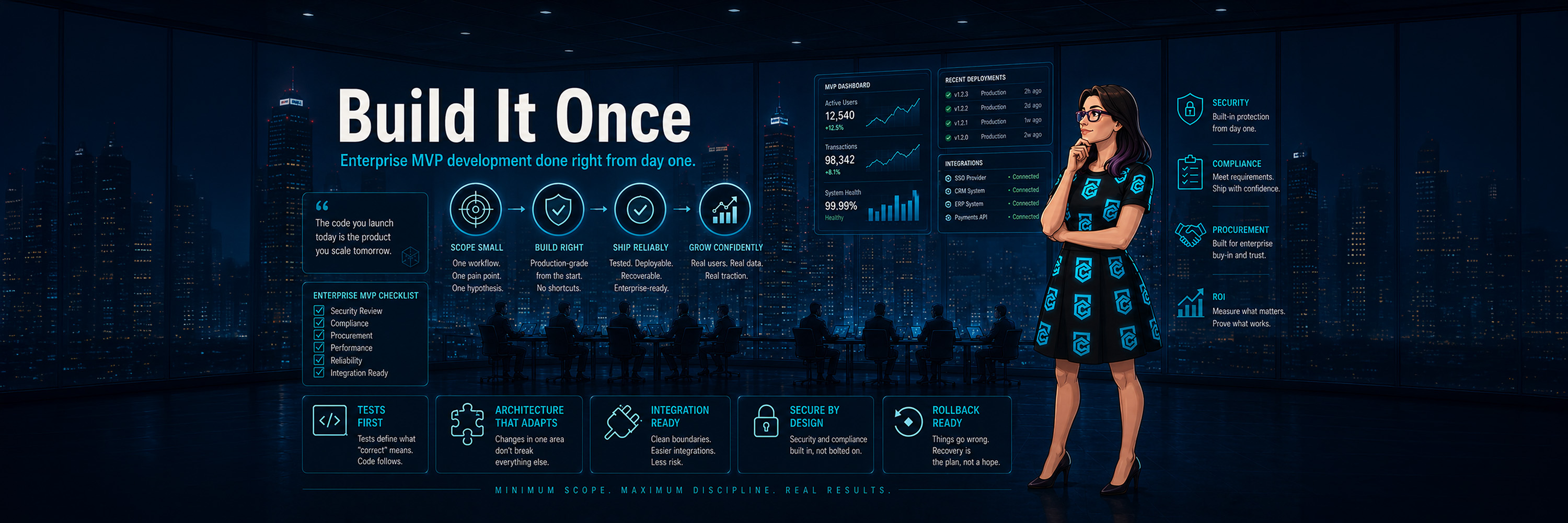
Enterprise MVP development is the practice of building a minimum viable product that meets enterprise-grade requirements — security, compliance, reliability — from day one. Your MVP has a procurement process to survive. A security review. A compliance checklist. A VP who put their name on the approval. Real users with real data and zero patience for "we'll fix that in the next sprint."
It has to live in that world from day one.
That's what makes enterprise MVP development fundamentally different from the startup playbook. The scope should be small — deliberately, strategically small. One workflow. One pain point. One clear hypothesis, validated under real conditions. But the quality has to be production-grade from the start, because enterprise clients don't grade on a curve.
The word "minimum" describes scope. Not quality. And that distinction is where the entire engagement succeeds or fails.
Why Your Enterprise MVP Will Become Your Product
Here's what every executive should know going in: the MVP is version one. The code that gets traction — that has users, has data flowing through it, has integrations wired up and stakeholders depending on it — that's the codebase your team is building on for the next two years. Maybe longer.
The plan is always to "harden it after launch." To "go back and add tests." To "refactor once there's revenue." But once the product is live, there's always something more urgent than fixing the foundation. That's not a failure of discipline. That's just the reality of a product with users.
So the question isn't whether the MVP will become the product. It will. The question is whether it was built like one from the start.
What to Look for in Enterprise MVP Development
Testing as specification. Before a feature is built, there should be a clear, executable definition of what "done" looks like. Acceptance tests that validate the workflow end-to-end. Unit tests written alongside the code, test-first, so that by the time the feature is complete, the proof that it works already exists. When you say "actually, we need it to work this way instead," a well-tested codebase tells the team exactly what that change affects. A codebase without tests forces them to guess.
Architecture that anticipates change. Components designed so that changing the interface doesn't require changing the business rules, and vice versa. This isn't over-engineering — it's the minimum structure required so that a change in one area doesn't cascade into every other area. MVPs exist to test hypotheses, and hypotheses get revised. The code has to be built for that.
Integration readiness. Enterprise MVPs almost always have to talk to existing systems — an ERP, an SSO provider, a legacy database, a third-party API. A well-structured MVP isolates those integration points so that when the second system comes along (or the first one changes its API), the core product doesn't have to be rewritten to accommodate it.
Security and compliance by design. Your security review shouldn't be an afterthought bolted on before launch. A well-built MVP makes the security review easier, not harder — because the boundaries are clean, the data flows are traceable, and the authentication layer isn't tangled into the business logic. Enterprise buyers care about this. Your development team should too.
A real rollback strategy. Things go wrong in production. The difference between a minor incident and a major one is whether the team has a procedure for reverting or just a plan to "push a hotfix." A rollback strategy isn't pessimism. It's professionalism.
What It Looks Like When It Works
When enterprise MVP development is done with this kind of discipline, you get something specific: a single workflow, executed cleanly. Real users generating real data at real volume. You can see exactly what the product does — and more importantly, you can see that it does it reliably, every time, under actual conditions and actual load.
That confidence doesn't come from the feature list. It comes from what's underneath — the test suite that verifies the system before every deployment, the architecture that lets the team iterate without breaking things, the staging environment with production-scale data that surfaces surprises before your users do, and the rollback strategy that turns a production issue into a five-minute recovery instead of an all-hands emergency.
We've seen this play out across multiple engagements. The teams that invest in the foundation up front spend their second and third quarters building features. The teams that skip it spend those same quarters debugging, untangling, and having hard conversations about timelines.
The Real Cost of Enterprise MVP Development
There are really only two ways an enterprise MVP engagement plays out.
In one version, speed is prioritized above all else. A working demo appears quickly. It looks impressive in the board deck. But within twelve months, the codebase can't accommodate the changes the business needs. The team slows down. Every feature takes longer. Every change introduces bugs.
And then the product hits real traffic. Enterprise means enterprise-scale users, enterprise-scale data. The queries that ran fine against a test database choke on production volumes. A file import that worked with fifty rows collapses at fifty thousand because nobody planned for chunking, concurrency, or what happens when that workload lands across multiple servers. The staging environment — if one exists — had a fraction of the data and none of the load. Everything that worked in the demo fails at scale, and now the team is firefighting performance while the feature roadmap stalls.
Nobody calls it a failure, but the product never reaches its potential. The mounting technical debt becomes a permanent drag on the business — and the performance problems become the kind of thing the team just learns to live with.
In the other version, durability and speed work together. It adds a few weeks upfront — typically two to four. The demo is just as impressive, but what's underneath is real — tested, structured, deployable, recoverable. The team knows which parts of the system are potentially expensive and has plans for when traffic scales. Staging has production-level data. The architecture accounts for what should be synchronous and what should be offloaded. Two years later, the team is still building on the same codebase instead of rewriting it.
You understand this tradeoff in other domains. Nobody hires the cheapest firm to build critical infrastructure and then acts surprised when it needs to be redone. Software shouldn't be the exception.
How to Evaluate an Enterprise MVP Development Team
Regardless of who you hire, these questions will tell you what you need to know:
"Show me a test from a recent project."
A team that writes tests can show you one in thirty seconds. A team that doesn't will talk about their testing philosophy instead.
"What happens when we need to change direction after launch?"
The right answer involves how the code is structured to isolate changes. The wrong answer is just the word "agile."
"How does your MVP handle integration with our existing systems?"
Listen for an answer about boundaries — adapters, interfaces, isolated integration points. If the answer is "we'll wire it up directly," that's a codebase that breaks when the external system changes.
"What's your rollback strategy?"
There should be a concrete answer. If there isn't, that tells you everything.
"Walk me through how a feature goes from idea to production."
Listen for a process — tests, review, deployment, verification. Not just "we build it and ship it."
How Clean Coders Studio Approaches Enterprise MVP Development
Every feature starts with a spec — an executable definition of what the feature is supposed to do, written before the implementation begins. From there, we build test-first: each unit of code gets a test before it gets written, so that by the time a feature is complete, it's already proven. This isn't something we mention in proposals and skip when the timeline gets tight. It's how we work. Every feature, every time. We've built production systems this way across multiple industries — and the test suite is always the reason those systems are still running and still evolving years later.
We help clients choose the language and tools that best fit their project — and we practice the principles that matter across all of them. Our architecture follows SOLID principles: single responsibility, clean interfaces, dependencies that point in the right direction. When your needs evolve (and they will), we change what needs to change without disturbing what doesn't.
And we scope aggressively. A good enterprise MVP isn't "all the features but lighter." It's one workflow. One pain point. One hypothesis, built well enough to validate under real conditions. Small enough to deliver in weeks. Solid enough to build on for years.
Minimum Scope. Maximum Discipline.
An enterprise MVP is a bet — that this product solves a real problem, that this market is worth entering, that this workflow is the one your users need most. It's a smart bet. Smaller and cheaper than building the full platform. But it's still a bet.
The discipline isn't what makes it more expensive. The discipline is what makes it worth placing. A tested, well-structured, deployable MVP produces real data for real decisions. It gives confidence to your client, to the development team, and to you.
If you're evaluating teams for an enterprise MVP engagement, we'd welcome the conversation.
Frequently Asked Questions
What is an enterprise MVP?
An enterprise MVP is a minimum viable product built for enterprise environments — organizations with procurement processes, security reviews, compliance requirements, and low tolerance for failure. "Minimum" refers to scope (one workflow instead of twelve), not quality. A good enterprise MVP is deliberately small and fully disciplined.
Why do enterprise MVPs need higher quality than startup MVPs?
Enterprise clients have procurement processes, security reviews, and internal stakeholders who approved the pilot. They expect reliable, production-grade software from day one — software that performs under real load, not just in a demo. A startup MVP can tolerate rough edges because early adopters expect them. Enterprise clients don't grade on a curve — if the MVP fails, the deal is over.
How much does an enterprise MVP cost?
The true cost depends on whether the MVP is built to last. A team that skips testing and architecture may deliver a demo faster, but the codebase typically can't support the changes or the traffic the business needs within twelve months — leading to either a costly rewrite or a permanent slowdown. A disciplined team invests more upfront but produces a foundation that compounds in value. The most expensive MVP is the one you pay for twice.
How long should enterprise MVP development take?
A well-scoped enterprise MVP — one workflow, one use case, built with tests and clean architecture — typically takes twelve to sixteen weeks. Proposals promising significantly less should be examined for what's being cut, because shortcuts in enterprise MVP development resurface as costs later.
What's the difference between an MVP and a prototype?
A prototype demonstrates a concept and gets discarded. An MVP validates a business hypothesis under real conditions and becomes the foundation of the product. If the code isn't built to last, it's a prototype that accidentally went to production.
How do you evaluate an MVP development team?
Ask to see a real test from a recent project. Ask what happens when requirements change after launch. Ask how they handle integration with your existing systems. Ask about their rollback strategy. Ask them to walk through how a feature moves from idea to production. Teams that build lasting MVPs answer concretely with evidence from their process.
What about security and compliance?
A well-built enterprise MVP treats security as architecture, not an afterthought. Clean boundaries, traceable data flows, and isolated authentication layers make your security review straightforward rather than painful. If the team treats compliance as a pre-launch scramble, the codebase probably wasn't built with enterprise requirements in mind.
What technology stack is best for enterprise MVPs?
The best stack prioritizes reliability, maintainability, and the ability to evolve. We help clients choose the language and tools that best fit their project, and we practice the disciplines that matter across all of them: test-driven development, SOLID architecture, and clean separation of concerns.